Subterranean termite soil treatments create an uninterrupted continuous treated zone in the earth directly adjacent to concrete footings and stem walls. Western subterranean termites nest deep beneath the soil surface…
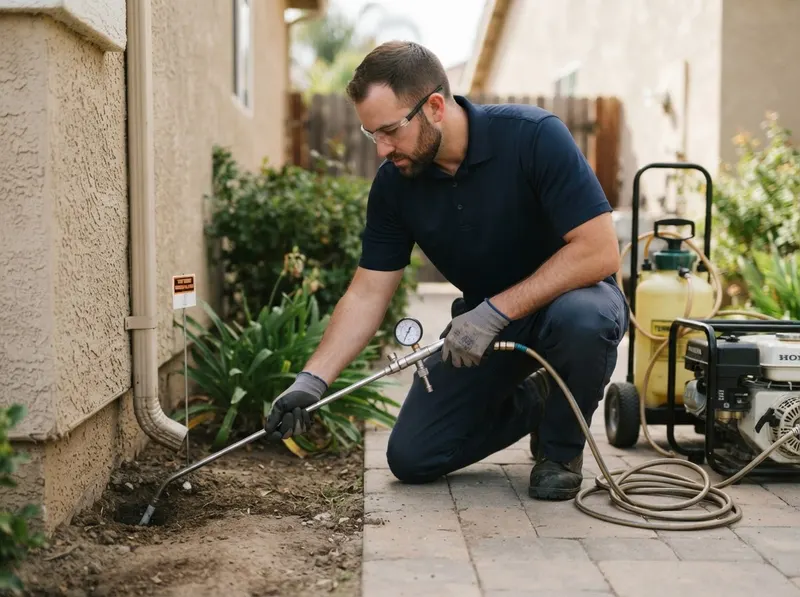
Subterranean termite soil treatments create an uninterrupted continuous treated zone in the earth directly adjacent to concrete footings and stem walls. Western subterranean termites nest deep beneath the soil surface to escape the intense heat of the San Joaquin Valley, entering homes through hairline foundation cracks as narrow as 1/32 of an inch. A non-repellent liquid termiticide binds directly to soil particles rather than repelling the insects. Foraging worker termites traverse the invisible barrier, pick up microscopic doses of the active ingredient on their cuticles, and transfer the material throughout the subterranean nest via social grooming. This mode of action neutralizes the entire reproductive caste without requiring broadcast chemical dispersal inside living quarters.
Treatment methodologies shift based on Fresno's varied architectural eras and soil compositions. Older raised-foundation residences throughout the Tower District and Huntington Boulevard Historic District require specialized sub-floor crawlspace trenching along interior pier blocks alongside continuous exterior perimeter work. Conversely, slab-on-grade homes constructed across Woodward Park, Bullard, and Fig Garden demand vertical sub-slab injection, where technicians drill 1/2-inch access ports spaced 12 inches apart through adjoining garage floors, driveways, and back patios to reach hidden grade stakes. Properties situated in Sunnyside and Hoover often feature heavy alluvial clay or hardpan layers that require specialized hydraulic rodding equipment to guarantee saturation to a standard depth of 4 feet.
1. Technicians complete an initial physical inspection to document mud shelter tubes along the foundation and record total linear footage. 2. Crews dig a 6-inch-wide by 6-inch-deep trench immediately adjacent to foundation walls. 3. Liquid termiticide is pumped into the trench at a calibrated rate of 4 gallons per 10 linear feet per foot of depth. 4. Attached flatwork is drilled and injected before sealing every access hole flush with matching structural mortar. 5. The displaced soil is mixed with the termiticide solution, backfilled into the trench, and tamped firmly into place. The primary structural trade-off centers on non-disruptive exterior trenching versus essential interior masonry drilling: treating strictly around the exterior soil leaves unsealed plumbing penetrations beneath an interior slab vulnerable, while drilling interior pads requires cosmetic surface patching.
Every job gets a firm, written price after a free on-site visit.
Tell us about your subterranean termite soil treatments job in Fresno and we'll send a clear, written quote, usually the same day.
 Truvexa Insect Control