Drywood termite localized injections serve property owners when colony activity is isolated to accessible wooden members, such as attic purlins, exterior rafter tails, and window casings. In the semi-arid Central…
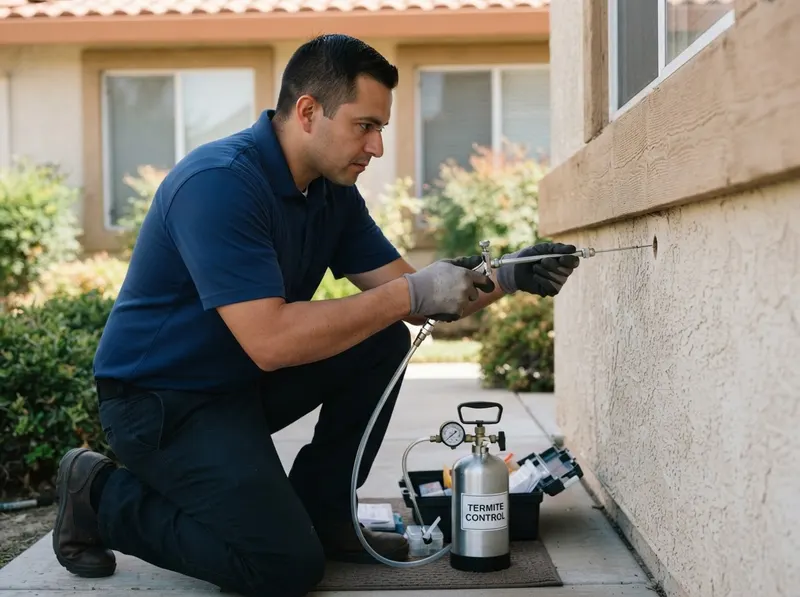
Drywood termite localized injections serve property owners when colony activity is isolated to accessible wooden members, such as attic purlins, exterior rafter tails, and window casings. In the semi-arid Central Valley climate of Fresno County, Western drywood termites (Incisitermes minor) frequently penetrate structural timbers through ventilation louvers, fascia boards, and perimeter eaves during seasonal swarms from late summer through October. Unlike whole-structure fumigation, which requires residents to move out for 72 hours, discard open pantry goods, and bag medical supplies, localized injection confines treatment chemicals strictly inside structural wood elements. Technicians use acoustic listening tools and moisture meters to track active galleries behind painted surfaces, drill 1/8-inch ports directly into the wood core, and inject calibrated termiticides under controlled low pressure. The trade-off centers on spatial spread: localized treatment stops contained, identified colonies with zero household displacement, but does not protect completely hidden or inaccessible structural timbers located behind masonry walls or layered plaster.
Building architecture dictates treatment precision throughout distinct Fresno communities. Older residences in the Tower District, Fig Garden, and the Huntington Boulevard Historic District feature unpainted heartwood lumber, rough-sawn rafter assemblies, and vintage shiplap that demand slow, low-volume localized injections to prevent staining or blowout through decorative lathe. Conversely, slab-on-grade tract homes built from 1980 onward in Woodward Park, Bullard, and Hoover commonly present drywood colony pockets isolated inside vaulted roof trusses and attic knee walls exposed to intense summer heat. Subdivisions near Sunnyside and agricultural margins around West Fresno and Roosevelt frequently encounter localized entry points where drywood alates land on sun-checked patio pergolas, storage sheds, and exposed eave fascia near landscape trees.
Execution requires systematic sequence steps rather than random surface spray applications. First, structural wood members undergo tactile sounding and thermal mapping to confirm the precise void limits of the termite gallery. Second, micro-apertures measuring 1/8 inch are drilled at staggered 4-to-6-inch intervals along the grain into the hollow gallery chambers. Third, non-repellent liquid or expanding foam termiticide is metered into the apertures until back-pressure confirms full saturation of the interior chamber. Fourth, injection points are sealed using color-matched hardwood dowels or structural wood sealant, securing the active chemical matrix deep inside the lumber. This targeted exterior and structural barrier method confines the compound strictly to the wood core, eliminating chemical drift into active indoor family living spaces.
Every job gets a firm, written price after a free on-site visit.
Tell us about your drywood termite localized injections job in Fresno and we'll send a clear, written quote, usually the same day.
 Truvexa Insect Control